PULPO-23
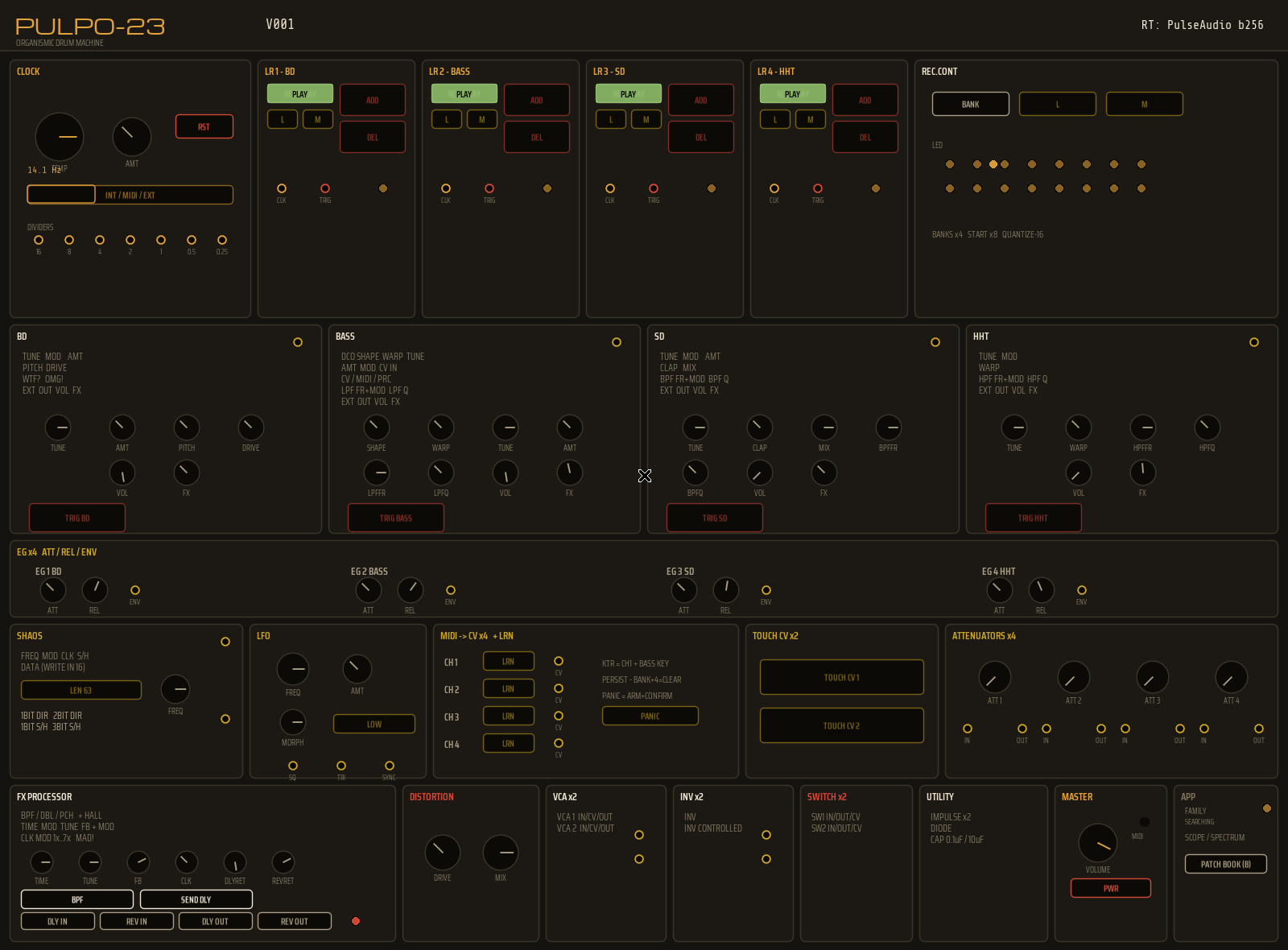
23 modules, 13 auxiliary units, 119 patch points — and no rigid linear structure. The machine boots already playing: clock running, a groove on the tape, four voices mixed. The patch graph is the program; every arm can lead.
DOWNLOAD — DROP 002
browse all drop files →
REQUIRES LÖVE 11.5 → love2d.org
linux via PipeWire/ALSA · windows via WASAPI · boots already playing — the groove rolls before you touch anything
THE ORGANISM LAW
"No rigid linear structure — any part can become, for a while, both leading and driven."
— the classic hardware's own manual, on why it works like a living system
Boots alive
Zero patch is already the drum machine: clock running, groove on the tape, voices mixed, a touch of FX. The novice path never opens the patch layer — and never needs to.
Paradox is the product
Patch two things that shouldn't be connected and the machine gets more musical, not broken. Audio is control; any out feeds any in; feedback is legal — the protection clamps make it safe, not silent.
119 points, one voltage
0–10 V, ±1 internal. Pins auto-negotiate direction like the hardware's impedance scheme, cables stack and chain, and the color tells you the carried signal: warm white audio · gold CV · amber clock · red gate.
CLOCK + LOOPER
The clock teaches the bar
Free-running 1–200 Hz with a CV-driven tempo bend, seven binary dividers (/16 … ¼), RST, and INT / MIDI / EXT sources. The boot patch feeds ¼ into LRST — the manual's own cure for looper drift.
Four channels of tape
128-tick loops sampled 96× per tick, 4 banks per channel, 8 start sections, quantize-to-16, punch-ins, and a one-pointer chord grammar (BANK+ADD/DEL steps, BANK+L stops, BANK+M jumps sections, BANK+L+M quantizes). Records the way the hardware feels — timing honesty is a test gate.
THE VOICES
BD · BASS · SD · HHT
BD with the 808 fall (ENV→MOD). BASS — a recursive-equation DCO, never a wavetable, with CV / MIDI / PRC modes and a state-variable filter. SD with the velocity-windowed clap. HHT with the folding sweep. Four analog-style envelopes, one per voice.
The weird ones
SHAOS — 63/16/217-bit register noise with sample & hold and a writable DATA pin. TOUCH CV — body-contact plates. MIDI→CV ×4 with learn and key tracking. Plus distortion, VCAs, inverters, switches, impulse converters, diode, capacitors — the circuit-bending drawer.
THE PATCH BOOK
Twelve factory patches from the manual's own examples — metronome, hip-hop pitch drop, sidechain pump, clock-as-kick, SHAOS audio-rate hats, diode velocity — each one a full-organism snapshot. Load a page and the machine comes up mid-idea; the patch view shows every cable. Then re-clip and make it yours.
MIDI
| BD / SD / HHT | notes 36 / 38 / 42, velocity = amplitude |
| BASS | chromatic 24–96, pitchbend ±12 st, CC05 portamento |
| CLOCK | 0xF8 streams, 24 ppqn — 3 messages per tick; transport recorded, never obeyed |
| LRN | four learnable MIDI→CV slots with key tracking; bindings persist in presets |
NEW IN DROP 002 — SONGS, THE WIRE, THE PANEL ROUND
Composed drum parts now travel with the score: the song
grammar gained lrStop (the factory looper yields to a composed part) and pitched events —
so PULPO can play a ground bass, not only drums. The family sessions ship five songs and a silent
keeper (moonlight, gymnopedie, mountainking, aquarium,
canon-drums, silent). Under a tempo ramp the clock stopped re-announcing the
transport every frame (one START, not thousands), the LRN surface learned arm-and-confirm clearing, and
the loop LEDs became live meters. The drums are audible on the wire now — the PCM tap streams the kit
into the room.
THE FAMILY
PULPO-23 is the rhythm hub of the ZRGRT trio — LUNAR-24, the microtonal ambient machine, and CATCH-22, the twin-mismatch stereo filter. The set connects itself over NYDUS: pulpo keeps the room's time.
FAMILY SESSIONS — HEAR THE TRIO
Four public-domain works, played live by LUNAR-24 + PULPO-23 + CATCH-22 over one NYDUS wire, captured as heard — no samples, no overdubs. Full notes on the LUNAR-24 page.
LUNAR the triplet arpeggios · PULPO one soft pulse per bar · CATCH filters the room
LUNAR two voices eight seconds apart · PULPO the ground bass · CATCH blooms at the third entry
the room steps 138→154 bpm over the wire · PULPO's march · CATCH blooms at the climax
fate knocks — the exposition · PULPO states the motif on timpani · CATCH the hall