This manual documents LUNAR-24 DROP 004 · build V004, an independent software
instrument for LÖVE 11.5. LUNAR-24 is not affiliated with, endorsed by, or a
reproduction of any hardware manufacturer; it is an original work inspired by classic
semi-modular ambient hardware. No hardware firmware or manual text is reproduced. All
audio is synthesized in code, and all artwork and diagrams are original.
PLATE 1 — The panel. Everything lives on one
1600×1034 surface: six drone voices around the effector, the two v/oct voices, the
ten-channel mixer, the dual filter and the twelve-plate keyboard.
#
MODULE
WHAT IT DOES
1
DUAL EFFECTOR (top centre)
Two cartridge slots — X / Y / Z, BLEND, MASTER; click the card for the WALLET.
2
DRONE 1 · 2 (top left)
Classic five-oscillator swarm voices with MOD orbs and env outs.
3
DRONE 4 · 5 (top right)
The same classic pair.
4
DRONE 3 (mid left)
Papa Srapa Schmitt pair: a square modulator drives FM/AM and S&H noise.
5
VCO A (mid left-centre)
Morphing AS3340-style voice; sync master.
6
VOICE MIXER (centre)
Ten channels with PAN + VOL; the channel label is its mute.
7
VCO B (mid right-centre)
Mirror of VCO A; A's output is normalled into its FM input.
8
DRONE 6 (mid right)
Second Papa Srapa voice; boots latched in FM+AM at ~3 Hz.
9
FILTER L / FILTER R
Centre, behind the EFFECTOR tab: dual 12 dB Polivoks-style LP/BP with drive and distortion.
10
LFO A (bottom far left)
Square↔triangle morph, unipolar 0…+10 V.
11
JOYSTICK (bottom left)
Position-locking X / Y with offset windows and four quadrant LEDs.
12
5 STEP SEQ. VOLTAGE (bottom centre)
Buchla-style 0…+5 V voltage source; shared pulser + PULSER 2/3 + S&H strip.
13
PREAMP + ENVELOPE FOLLOWER (bottom right-centre)
Mic / line input; ENV CV + gate output.
14
LFO B (bottom far right)
Second morphing LFO.
15
SENSOR KEYBOARD (bottom centre)
Twelve touch plates in two arcs; performance strip above the left arc.
16
DRONE VOICES keypad (bottom right)
2×3 momentary gates — same as computer keys 1–6.
17
Utility bar (top right)
S save · L browser · SCOPE · SKIN · ? help · P patch bay.
The machine's nouns
NOUN
MEANING
plate
One of the twelve touch keys of the sensor keyboard.
arc
Half of the keyboard: six plates left or right of the eclipse.
voice
A sound generator — six DRONE voices plus two melodic VCO voices (A/B).
swarm
The five sawtooth generators inside a classic drone voice (1, 2, 4, 5).
orb
The moon-disc photo-detector beside each drone block; shade it to bend pitch.
cartridge
An effect card — 15 of them, three programs each — loaded into the effector.
wallet
The cartridge browser; click the loaded card to open it.
comb
The effector-combiner: the dual cartridge chassis with BLEND and MASTER.
strip
The keyboard control strip above the left arc.
bay
The patch bay (P) — every source and destination in one view.
Reading the panel — knob colour grammar
Both skins (lunar, solar) obey the hardware grammar.
COLOUR
FAMILY
WHERE YOU MEET IT
blue #2979ff
modulation sources
LFO, pulser and S&H clocks, joystick, arp RATE/INT
green #2bc7ab
S&H / "sound machine"
Sample & hold and the noise voice
orange-red #d1541c
destinations
Filter cutoff/resonance, sequencer stage knobs, preamp and envelope controls
The instrument boots already droning. Voices 1, 2 and 6 are latched,
the boot preset is loaded, and the factory patch is in place:
LFO_A → MIX_CUT_R, JOY_Y → MIX_CUT_L,
JOY_X → DRONE_PITCH.
Listen. Do not touch anything yet. The machine is playing itself.
Take the joystick. It is position-locking: throw it and it stays. The filter opens
on Y and the swarm bends on X.
Touch a plate. Press to sound; hold to swell the pressure; drag vertically for
direct control. Shift+click (or right-click) latches a note at 75% pressure.
Gate the drones. Keys 1–6, or the DRONE VOICES keypad, open
the six drone voices while held (they latch in HOLD mode).
Shade an orb. Move the cursor over a moon-disc beside a drone block; pitch drifts
like a hand over a photocell.
Open the patch bay (P) when you want to see the wiring;
SPACE dims the layer. H opens the in-app manual overlay,
TAB the scope.
Housekeeping
GESTURE
WHAT IT DOES
S / F5
save a timestamped preset; L opens the browser.
F9
start/stop a master-bus recording (48 kHz / 16-bit stereo WAV, ~11.5 MB/min, capped at 30 min / 2 GB per take).
ESC (hold ~0.5 s)
quit — a ring fills at the bottom bar; a bare tap is safe.
CAUTION — LUNAR-24 is a live-performance instrument.
Presets are your safety net: save often (S), and let the machine keep droning
while you patch.
NOTE — If you hear nothing, the device may have refused the
native real-time bridge; the app then runs silently and the HUD shows
NO AUDIO - SEE LOG. Recovery and power-user knobs are in
Appendix D.3.
1THE MACHINE
An instrument begins as a landscape. This one begins as a night sky
already sounding.
LUNAR-24 is an experimental microtonal ambient drone machine. Eight voices
— six drone swarms and two melodic VCO voices — run as separate blocks into a mixer with pan,
a double filter, a distortion stage and a double effector. CV sources are routed through a
patch bay. The intent: build full-blown drone and ambient tracks without multitracking — one
gesture per limb keeps eight voices evolving.
BLOCK
WHAT YOU GET
6 DRONE voices
5 sawtooth oscillators each; voices 3 and 6 are Schmitt-pair Papa Srapa voices (square modulator → FM/AM + S&H noise).
2 V/OCT voices
VCO A/B: morphing waveforms, PWM, linear FM, sync, sub oscillator, ADSR + M loop, per-voice filter.
Filters
Dual 12 dB Polivoks-style (LP/BP, EXP/LIN, drive, distortion).
Effector
Dual cartridge combiner — 15 cartridges × 3 programs = 45 programs (13 derived from the reference card set + 2 app-original: MOONDOG, ECLIPSE).
Mixer
10 channels with pan; EXT.AUDIO and mic PREAMP channels.
40+ sources × 28+ destinations on a live blueprint: module schematic cards, tap source → tap dest, flow register with amount meters, undo — the wire is a graph, not a drawing.
48 kHz stereo, pure-code DSP; the native real-time audio bridge is the only engine (256-frame ring blocks), starting at boot with default pacing vsync off + cap 120 — the low-jitter studio posture. If the bridge or device refuses, the app runs silently and the HUD shows NO AUDIO - SEE LOG (power-user envs: Appendix D.3).
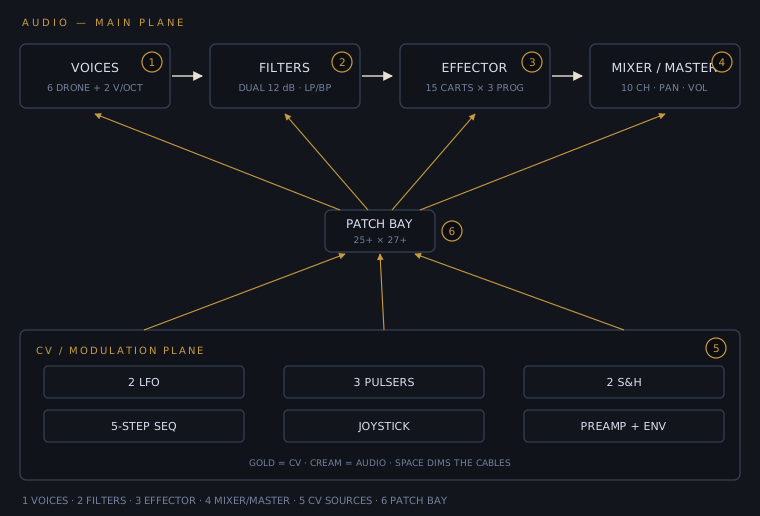
FIG. 1.1 — The machine on one page:
audio crosses left to right in cream; voltage rises from the CV plane through the patch bay
in gold. Callouts — 1 voices · 2 filters · 3 effector · 4 mixer/master · 5 CV sources ·
6 patch bay.
Boot state. Everything lives on one 1600×1034 panel. It boots already droning: voices
1, 2 and 6 are latched, a boot preset is loaded, and the factory patch
LFO_A → MIX_CUT_R, JOY_Y → MIX_CUT_L, JOY_X → DRONE_PITCH
is in place.
2SIGNAL FLOW
Sound travels in one direction. Voltage travels wherever you patch it.
FIG. 2.1 — Signal flow: audio chain
above, CV routing below. Links in the patch bay follow the same colour grammar.
STAGE
MODULE
PATCH / PRESET NAMES
Voices
DRONE 1–6, VCO A/B
ENV_1…6, ORB_1/2/4/5, EG_4/5
Mix
VOICE MIXER — 10 ch, PAN + VOL
—
Filter
FILTER L/R — 12 dB Polivoks, LP/BP
MIX_CUT_L/R, MIX_RES_L/R
Distortion
DRIVE + DIST per filter side
—
Effector
DUAL EFFECTOR — two cartridge slots
CART_X/Y/Z, CART_CV1/2/3, BLEND
Output
WET OUT; DRY sends and EXT.AUDIO / PREAMP feed the mixer
drySends.v4/v5
Each VCO voice also has a dry output (VCO A/B pre-filter, max 1 V); EXT IN
with a preamp and the mic feed the mixer directly.
3THE CLASSIC SWARM — DRONE VOICES 1 · 2 · 4 · 5
Five sawtooths, one register ladder, no pitch input: tune it the way
you tune a room.
Five sawtooth generators per voice in a register ladder — oscillators 1–2 low,
3 medium, 4–5 high (≈B0–D7). No V/oct: tune by ear, mute to build chords, and let the orb
bend pitch with the light.
CONTROL
RANGE
WHAT IT DOES
TUNE ×5
±1 octave (fine cents)
Per-generator tuning. Hardware has no V/oct input, only knobs.
LEVEL ×5
0–1
Per-generator level into the voice.
MUTE ×5
on/off
Kills that generator; the 1–5 LED strip at the block edge lights for a muted oscillator.
MOD ×5
on/off
On: the generator follows the orb, DRIFT and DRONE_PITCH CV. Off: "generators run stably, without deviations".
register ladder
0 / +1 / +2 / +3.5 / +5 oct above BASE
The five generators' fixed octave offsets (continuous in software; discrete fixed ranges on hardware).
SUB tap
square, osc-1 ÷ 2, −12 dB
Fixed low-end anchor under the ladder.
detune chorus
±12.8 cents, stereo-spread
Rides on top of the ladder; mutes build chords across the registers.
VOLT
−1…+1
Negative half transposes the voice down (to −2 oct); positive half is the cross-FM depth between the five generators (neighbour taps 0.5/0.4/0.3/0.2), scaled by the voice's AR envelope. Bipolar is a kept divergence (hardware transposes down, then cross-FMs past half-stroke).
HOLD / GATE
on/off
HOLD latches the voice on; GATE sounds only while pressed (keypad or keys 1–6).
ATT
1 ms–4 s
Attack of the AR VCA envelope.
RLS
10 ms–8 s
Release.
env LED + env out
0…+1 (≙ 0…+10 V)
Envelope indicator; patch source ENV_1…ENV_6.
DRIFT
0–50 cents
Ornstein–Uhlenbeck random walk, block-size-invariant (driftTau 0.01–60 s via preset); sign alternates per oscillator, chorus width breathes over 20–40 s, per-osc AM wobble 0.15–0.5 rad/s.
orb
up to +8 cents
Photo-detector at the block's right: shade with the cursor; patchable as ORB_1/2/4/5.
FIELD NOTE — the 1–5 LED strip lights for a muted oscillator.
On LUNAR-24 the light shows what is off, so a dark strip and a lit strip are both correct —
read the labels, not the glow.
→ SEE ALSO — §8 for SAH_A/SAH_B;
§16 for orbs in the patch bay.
4PAPA SRAPA — DRONE VOICES 3 & 6
Two Schmitt triggers arguing at audio rate — the machine's most
organic voice.
Two Schmitt-trigger oscillators: a low-frequency square modulator and an
audio tone. Switch combinations give drone, FM, AM or noise — sirens, surf, monsters, volleys.
CONTROL
RANGE
WHAT IT DOES
RATE + ×1/×10
1–20 Hz (log)
The square modulator's clock.
DIVIDER
÷1–8
Subdivides the modulator; the FM/AM pattern repeats at RATE ÷ DIVIDER. Also divides the internal S&H clock.
FM / AM switches
on/off
off/off = continuous drone · FM only = pitch wobble · AM only = amplitude wobble · both = FM+AM. (papaMode 1–4 in presets; 5 = clean noise.)
MOD
0–2
Depth: FM bends pitch by 2^(MOD/2) — ±6 st at 1, ±1 oct at 2; AM swings amplitude full → 1 − MOD/2 (silence at 2).
DRONE3/6_PITCH · DRONE3/6_FM
±1 oct (pitch)
Patch destinations for external pitch and depth control.
PITCH
20–400 Hz
Audio square fundamental; hardware C0–E7 approx.
OCT · LO/HI
−2…+2 (integer) · one octave
Range switch and octave toggle.
NOISE
0–1
White noise into the voice (LED tracks it) — also the S&H source.
S&H
0–1
Depth of the random steps on tone pitch (±4 st at full).
clock in
PAPA3_CLOCK / PAPA6_CLOCK
Any clock or LFO samples on each rising edge; unpatched, internal clock = RATE × range ÷ DIVIDER.
HOLD / GATE · ATT · RLS · env out
as classic voices
1 ms–4 s attack, 10 ms–8 s release; ENV_3 / ENV_6.
PAPA_3_MOD / PAPA_6_MOD
0…+1.2 (≙ 0…+12 V)
The modulator square as a source, unipolar.
clean noise
engine papaMode 5 / "noise"
Dial PITCH to minimum, NOISE up, MOD and DIVIDER high (FM/AM off).
At boot voice 6 is latched on in FM+AM at ~3 Hz — a brief, musical wobble.
→ SEE ALSO — papa mode codes, Appendix D.4; the
sample-and-hold strip, §8.
5THE MELODIC VOICES — VCO A & B
Two triangle cores, six shapes between them, and a sync that bites.
AS3340-style triangle-core oscillators, six waveforms, cross-normalled A↔B;
VCO A carries the sync that resets VCO B.
CONTROL
RANGE
WHAT IT DOES
MORPH
0–5
SINE → TRI → SAW → INVSAW → SQR → PULSE; one continuous axis, readout shows the nearest shape.
TUNE
±0.5 oct (1 oct of travel)
Hardware is a one-octave knob 0…+1; software is bipolar.
VIB
0–1
Vibrato depth (rate from the strip VIB R / RATE B).
SUB knob + button
0–1 (0.35 default)
Square sub at half frequency.
PAN
L–R
Constant-power pan into the mixer.
PWM
0–1
Pulse width for the pulse frames; CV dests VCO4_PWM / VCO5_PWM.
FM
unipolar: 0 → +0.68 oct @ 25% → +3 oct @ full
Linear FM depth; cross-normalled A↔B. Dests VCO4_LINFM / VCO5_LINFM.
OCT+3 / LOW · −1
switches
Octave range and sub-octave.
SYNC (VCO A)
button / VCO4_SYNC > 0.5
A's phase wrap resets B (B is slave); hard reset carries phase jitter + a 2 ms noise pip — the classic 3340 growl. A rising edge on the VCO4_SYNC CV additionally hard-resets A's own phase (and holds the pair linked while the CV stays high).
1v/oct
12 st per volt
True 1 V/oct: the keyboard's +8 V is 8 octaves. Dests VCO4_PITCH / VCO5_PITCH.
cv / pwm / sync jacks
—
VCO4/5_LINFM, VCO4/5_PWM, VCO4_SYNC.
per-voice filter
20 Hz–20 kHz
LP/BP, EXP/LIN (20 Hz·2^(10x)), CUTOFF / RES / DRIVE / DIST — a LUNAR-24 addition (hardware has only the master filters).
ADSR A / D / S / R
1 ms–4 s / 1 ms–4 s / 0–100% / 10 ms–8 s
Envelope.
GATE · HOLD · M
buttons
GATE fires; HOLD keeps the VCA open; M loops the attack→release cycle continuously (D/S bypassed) at any A/R — self-running modulation, no gate needed.
EG_4 / EG_5
0…+8 V
Envelope as a patch source.
DRY
0–1
Raw morph output, pre-envelope and pre-filter, onto the main bus (drySends.v4/v5).
FIELD NOTE — self-running drone: press M. The envelope loops,
and the voice drones itself — no gate, no keyboard, no hands. Slow or fast is A and R.
→ SEE ALSO — §10 for the keyboard's V/oct normals;
§16 for EG_4/EG_5 in the bay.
6THE LOW-FREQUENCY OSCILLATORS — LFO A & B
The tides: two unipolar clocks that feed the orbs and the filter.
CONTROL
RANGE
WHAT IT DOES
WAVE
square ↔ centre mix ↔ triangle
Continuous morph; boots at centre (50/50). Kept exactly from hardware. Sine/saw/ramp remain reachable as patch sources only (VCOA_SINE, VCOA_SAW, …).
RATE + ×1/×6/×10
0.02–20 Hz (log)
Rate; the switch multiplies. Both LFOs run the same range — hardware doesn't specify per-LFO.
out + LED
0…+1 (≙ 0…+10 V)
Unipolar by design (feeds the orbs and other CV dests); sources LFO_A / LFO_B; LED lights above mid-swing.
7THE JOYSTICK
Throw it, leave it. The joystick remembers where the performance was.
Position-locking: throw it and it stays. Click to jump, drag to position;
arrow keys nudge.
CONTROL
RANGE
WHAT IT DOES
pad
X, Y ±1 (≙ ±10 V)
The physical gesture; out = 0.5·axis + offset, clamped.
X / Y knobs
±1
Mirror the pad position.
OX / OY
±0.5
Offset windows: left −10…0 V, centre −5…+5 V, right 0…+10 V (the knob shifts the window by ±5 V).
quadrant LEDs · JOY_X / JOY_Y
—
Active-quadrant indication and patch sources.
FIELD NOTE — the joystick is two patch sources and two knobs at once.
Let the offset windows do the transposing: OX at centre gives a ±5 V bend, OX left gives a
one-way dive to −10 V.
→ SEE ALSO — the factory patch, §16; arrow-key
nudging, Appendix D.1.
8THE FIVE-STEP SEQUENCER & PULSER
Not notes: voltages. Five stages, one shared clock.
A Buchla-inspired source of voltage, not a note sequencer: five stages, each a
continuous 0…+5 V.
CONTROL
RANGE
WHAT IT DOES
PULSER
0.25–20 Hz
The one shared clock: source PULSER_1, sequencer internal clock, S&H A's external clock, keyboard external beat.
CLK (SEQ_CLOCK)
—
Free-running pulse output — emits whether or not the sequencer runs.
STAGES
3 / 4 / 5
Cycles the number of active steps; step LEDs show the running stage.
Gate off kills that step's pulse, not its CV (SEQ_GATE).
GATELN
20 ms–1 s
Gate pulse length.
INT/EXT + P1/KEY
—
INT runs from the PULSER; EXT from Pulser 1 or the keyboard beat. Patch SEQ_EXT_CLOCK advances on rising edges.
PULSER 2/3
RATE + WIDTH
Free-running patch clocks (PULSER_2, PULSER_3).
S&H A/B
RATE + INT/EXT
A clocks from Pulser 1, B from the sequencer gate (P1 / SEQ); sources SAH_A, SAH_B.
The keyboard has its own clock and sequencer: KEY_CLOCK,
SEQ_KBD_CV / SEQ_KBD_GATE (see §11).
→ SEE ALSO — the keyboard clock, §11.5;
SEQ_CV among the voltage specs, Appendix A.
9THE PREAMP & ENVELOPE FOLLOWER
The hardware senses tapping through a piezo under its keyboard; the software takes the system input instead.
The preamp takes the system recording device — an external microphone or line source — captured at 8 kHz
mono, feeding the follower and the EXT.AUDIO mixer strip.
CONTROL
RANGE
WHAT IT DOES
GAIN
1–100 (0…+40 dB)
Audio-path gain; the bottom mutes (hardware "set GAIN to minimum" rule).
EXT in (EXT_SRC)
line / instrument
In LUNAR-24, EXT.AUDIO is its own mixer channel and extAudio has no live source yet (the jack is silent for now; the mic path is live).
ENABLE
on/off
Routes the channel into mixer strip 4 (EXT.AUDIO).
MIC
arm / idle
Arms the system input device for the preamp and follower (Bluetooth and monitor devices are skipped). Master-bus WAV recording is separate: F9 starts/stops it, and it never auto-starts (unless LUNAR_REC=1 is set — see §16).
clip LED
> 0.98 FS
True post-gain clip indicator, holds 1.5 s.
FOLLOWER ATTACK / RELEASE
1–100 ms / 50 ms–1 s
Envelope follower slopes; vertical CV meter.
GATE LED
on > 15%, off < 10%
Hysteresis gate activity.
ENV_CV / ENV_GATE
0…+1 / 0…+0.8 (≙ 0…+10 V / +8 V)
Patch sources; without a mic the strip reads NO MIC and the follower sits at zero.
10THE SENSOR KEYBOARD — PLATES & JACKS
Twelve plates, two arcs, an eclipse between them.
Twelve capacitively sensitive plates in two arcs of six. Pressure follows
finger surface area, not force.
PLATE 2 — Sensor keyboard: twelve
plates in two arcs, centre clock and transpose cluster. The centre button carries
its state as a glyph — triangle = stopped, bars = running.
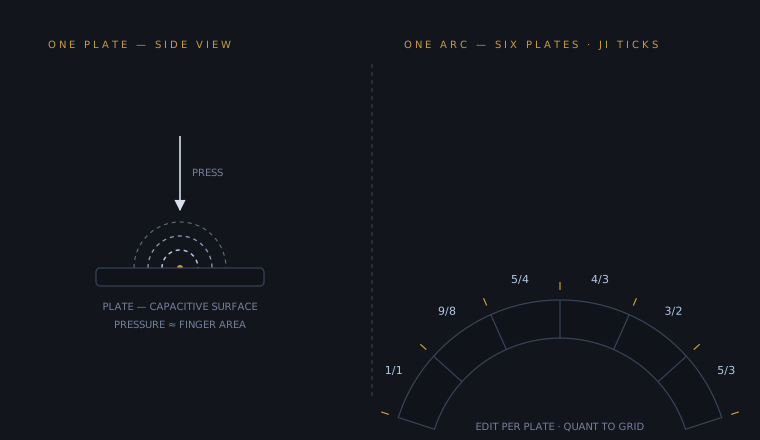
FIG. 10.1 — One plate, side view:
pressure follows finger area — hold to swell, tip to stab. One arc of six, with the
5-limit just-intonation tick marks the quantiser can snap to.
CONTROL / JACK
RANGE
WHAT IT DOES
plates
12, two arcs
Press/drag a note; hold to swell pressure (≈1.5 s ramp) or drag vertically for direct control.
latch
Shift+click / right-click
Latches a plate as a drone note at 75% pressure; click again to release.
Resets arpeggiator/sequencer; a preset-settable clock reset flag.
DRONE VOICES keypad
2×3 pads 1–6
Momentary gates for the six drone voices — same as keys 1–6.
FIELD NOTE — pressure follows surface area, not force. To swell a note,
flatten the finger and hold; to stab, touch with the tip. The same physics runs the
PRESSURE source into the VCO filters.
→ SEE ALSO — the strip that reads all of this, §11;
pressure modes, §11.5.
11THE KEYBOARD STRIP
The performance brain lives above the left arc.
The strip is a second, self-contained instrument: scale and quantiser, split
modes, arpeggiator, sequencer, glide, vibrato and pressure — all read from the plates below.
11.1 Scale & quantiser
CONTROL
RANGE
WHAT IT DOES
SCALE <>
25 banks
12 / 19 / 24 / 31 / 41-TET, JI 5-limit major, and all 19 named hardware scales (Semitones, Ionian, Dorian, Phrygian, Lydian, Mixolydian, Aeolian, Locrian, Blues major/minor, Pentatonic major/minor, Folk, Japanese, Gamelan, Gypsy, Arabian, Flamenco, Whole tone). Readout shows name + BANK n/N.
.scl import
drag onto window
Appends a Scala scale (cents and ratio lines accepted); saved inside presets.
QUANT
on/off
Off: continuous microtonal keyboard (drag vertically to sweep between neighbours). On: snaps to scale; per-bank mask applies.
ROOT
55–440 Hz (log)
Quantiser root.
11.2 TWIN / SPLIT
CONTROL
RANGE
WHAT IT DOES
TWIN
6+6
Left six plates drive VCO A, right six VCO B, each side tracking its own loudest plate; every parameter shared.
SPLIT
6+6
Same split, plus independent per-side arp and seq controls (ARP R / SEQ R).
11.3 Arpeggiator
CONTROL
RANGE
WHAT IT DOES
ARP
on/off
Walks the pressed plates in plate order (left→right, per-plate edits included, duplicates deduped).
RATE
0.5–16 Hz
Free-run rate when CLK is OFF.
INT
1–12
Semitone transposition per VARIATION pass.
CLK
OFF / ¼ / ½ / ×1 / ×2 / ×4
Multiplies/divides the keyboard clock; OFF = free-run.
HOLD
on/off
Snapshots the held chord; the snapshot survives release, later presses extend it.
direction
UP / DN / PP / RND
Up / down / ping-pong / random.
VARIATION
OFF / ×1 / ×2 / ×3
Repeats the progression transposed by INT, cycling at any pattern length.
RHY
8-step row, length 1–8
Gold-dot rhythm gate (drag to paint); notes gate at 75% of each step.
11.4 Keyboard sequencer
CONTROL
RANGE
WHAT IT DOES
SEQ
on/off
Advances only while a plate is held (keyboard run mode).
LEN
2–16
Sequence length.
DIV
¼ / ½ / ×1 / ×2 / ×4
Division of the keyboard clock.
SEQ E
editor
Drag each step's pitch bar (0.00–0.50 V readout), click the dot row for gates (drag paints), paint the 8-step RHY rhythm row.
step pitch
0…+600 cents
Added to the last held plate pitch (quantised when QUANT is on); gates default on.
DIR
FWD / BACK / PP / RND
Direction.
CV
CONT / GATED
Continuous, or only while the step's gate is on; sources SEQ_KBD_CV / SEQ_KBD_GATE.
11.5 Glide, vibrato, pressure, clock, presets
CONTROL
RANGE
WHAT IT DOES
GLIDE
0–0.3 s
Portamento on both VCOs. LEGATO: glide suppressed for single-plate play, applies with ≥2 plates; no effect while the arp runs (glide always applies).
VIB D / VIB R
depth 0–1 / rate 2–8 Hz
Vibrato for VCO A. VCO B has its own VIB depth and RATE B in the VIBRATO block.
VIBRATO DELAY
0–10 s (0.3 default)
Ramp-in after each new gate; after the delay the engine ramps vibrato in linearly to full strength over ≈0.3 s.
PCTL
on/off
Pressure scales each voice's vibrato depth from 30% to 100% (vibPressureCtl, preset round-trips).
PRESSURE mode
PRESS / ASR / AD / LOOP / RND
PRESS follows plate pressure; ASR rises/falls with playing; AD one attack–decay per press; LOOP repeats while held; RND latches a new random level on each plate press and glides at the RISE/FALL slopes (RATE does not re-roll while a plate is held). Exposed as PRESSURE; hard-patched +20% into both VCO filter cutoffs.
RISE / FALL / RATE
1 ms–10 s / 1 ms–10 s / 0.01–50 Hz
Pressure slopes; RATE is the free-run rate of the pressure machine (no per-hold re-roll in RND).
clock
10–300 BPM (120 default)
Red button run/stop; BPM stepper (− / readout / +) edits tempo; round-trips as keys.clock.bpm. External KEY_CLOCK_IN pulse auto-switches to external; editing BPM reverts to internal.
PRESETS A–D
4 slots
Hold ~0.6 s to save the whole keyboard state (scale/quantiser, root, mode, legato, transpose, arp, sequencer, per-plate edits, glide, vibrato, pressure) to data/presets/kbd_A…D.json; click to load live. Tempo is deliberately excluded.
FIELD NOTE — the channel label is the mute. Click a name to silence a
voice without losing its level — the fastest way to thin a drone.
13THE DUAL FILTER
The Polivoks stance: resonance that keeps its low end.
A double 12 dB Polivoks-style filter — stable, no tuning, and “you will not
lose low frequencies when increasing resonance”. FILTER L / R live under the EFFECTOR tab.
CONTROL
RANGE
WHAT IT DOES
FREQ
20 Hz–20 kHz
Cutoff; exponential law default (20 Hz·2^(10x)); CV dests MIX_CUT_L/R.
RES
0–1
Resonance; keeps the low end while it climbs. Dests MIX_RES_L/R.
DRIVE
0.5–8
Distortion amount (hardware GAIN). Above 2 a post-filter VCA aggression stage engages on the mix filters — the drive stops being input warmth and gains post-loop crunch that rises with RES.
DIST
0–100%
Distorted-signal balance, with 70/30 crossfeed between channels.
LP/BP · EXP/LIN
buttons
Mode and CV law per side.
MOD L / MOD R
0–1 (default 1)
CV amounts for MIX_CUT_L/R; CV L is normalled to CV R when nothing is patched there — the hardware rule.
LINK
off by default
CV-only, the hardware rule: the left cutoff CV drives both filters; the right FREQ and RES knobs stay fully independent while linked.
boot mismatch
per-start seeds
The two channels are deliberately not bit-identical — the "live stereo" stand-in.
MASTER (wet volume) lives on the effector, right of BLEND.
14THE DUAL EFFECTOR
Two cartridge slots; the filtered mix goes through the cards.
A dual cartridge combiner fed by the filtered mix. CV X / Y / Z (±10 V)
control the loaded programs; BLEND is the effect level, MASTER the wet volume.
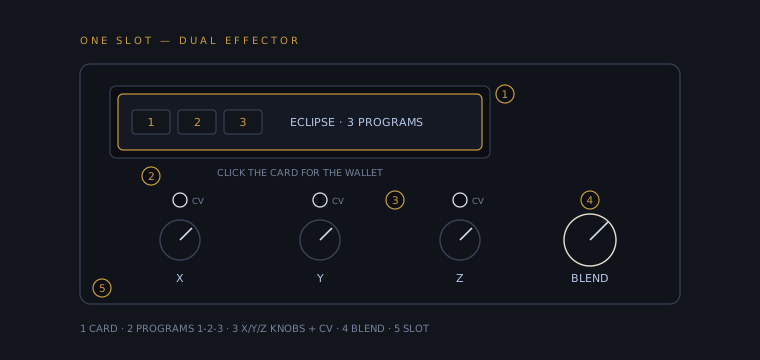
FIG. 14.1 — One slot, line art:
1 card · 2 programs 1-2-3 · 3 X/Y/Z knobs + CV · 4 blend · 5 slot. The other slot is
its mirror; each channel remembers its own X / Y / Z.
CONTROL
RANGE
WHAT IT DOES
L / R
select
Active channel; each channel remembers its own X / Y / Z (CART_X/Y/Z, CART_CV1/2/3, BLEND sum with the knobs).
X / Y / Z
0–1 + CV
Program parameters of the active slot.
1 / 2 / 3
programs
Select the active slot's program from the loaded card; RST resets to program 1.
BYP L / BYP R
on/off
Per-channel bypass.
cartridge card
click
Shows the loaded card + its three programs; opens the WALLET (click a card to load, ESC or click outside to close).
BLEND
0–100%
Wet crossfade.
MASTER
0–1
Output volume.
routing modes
normal / swap / cascade / loop / M-S
Engine-state software extra.
15THE CARTRIDGES
Fifteen cards, three programs each — the color of the machine.
Fifteen cards, three programs each. X / Y / Z per program:
CARTRIDGE
PROGRAM
X
Y
Z
CATHEDRAL — various reverbs
Shimmer
Octave up
Octave down
Decay
Oct up delay
Feedback
Delay
Reverb
Space reverb
Feedback
Delay
Reverb
MAGIC — pitched delays
Pitch delay
Feedback
Delay
Pitch
Reverse Pitch delay
Feedback
Delay
Pitch
Bell pitchdelay
Feedback
Delay
Pitch
TIME — classic mod delays
Delay reverb
Feedback
Delay
Reverb
Delay chorus
Feedback
Delay
Mod depth
Delay Vibrato
Feedback
Delay/vibrato rate
Mod depth
VIBROTREM — modulation
Tremolo
Depth
Rate
Reverb
Vibrato
Depth
Rate
Reverb
Chorus
Depth
Rate
Reverb
FILTER — filter and wah
Auto Wah
Filter amount
Envelope
Reverb
HP/LP filter
HP cutoff
LP cutoff
Resonance
Notch filter
Cut 1
Cut 2
Resonance
VIBE — rotary phase mods
Phaser
Depth
Rate
Reverb
Flanger
Depth
Rate
Reverb
Resonance flanger
Resonance
Rate
Mod depth
PITCH SHIFTER — octave and pitch
SynthTaver
Octave down
Octave up
Direct
Octaver
Octave down
Octave up
Direct
Pitch Harmonizer
Pitch 1
Pitch 2
Voice mix
INFINITY — big ambient
Resonance Reverb
Pre delay
Pre delay mod
Decay
O.D.D oscillating dirty delay
Feedback
Delay
Pitch
Resonance Delay
Feedback
Delay
Pitch
STRING RINGER — audio-rate mod
Synthetic Ring
Frequency
Resonance
Sub
Ring Mod
Frequency
Rate
Reverb
S&H Ring Mod
Pitch Speed
S&H Rate
Freq Ring Mod
SYNTEX-1 — bass synth
Vibe Synth
Vibrato Rate
Resonance
Sub
Pulse Synth
Tremolo Rate
Resonance
Sub
Acid Synth
Tone
Color
Sub
DIGITAL — sample-rate crusher
Filter DAC
Sample rate
Cutoff
Input gain
LFO DAC
Sample rate
LFO speed
LFO amount
Envelope crusher
Sample rate
Envelope amount
Input gain
GENERATOR — noise mini synth
FM tone
Pitch 1
Pitch 2
FM 2-1
Ramp
LFO rate
Pitch
Pitch mod +/-
Voice
Cutoff
Pitch
LP/HP
ORCHE — reverse delay
One-shot Long
Delay time
Feedback
Trigger threshold
One-shot Short
Delay time
Feedback
Trigger threshold
Free-run Loop
Delay time
Feedback
Delay mod LFO/RND
MOONDOG — street canon delay
Two-Voice Round
Canon spacing
Voice decay
Attack crisp
Street March
Canon spacing
Voice decay
Attack crisp
Percussion Canon
Canon spacing
Voice decay
Attack crisp
ECLIPSE — umbra corona sweller
Totality
Umbra depth
Corona level
Eclipse rate
Ring of Fire
Umbra depth
Ring focus
Eclipse rate
Corona Chorale
Umbra depth
Octave/Fifth
Eclipse rate
The reference table's thirteenth card is a reverse-delay card; LUNAR-24 ships ORCHE
in that slot. Two cards are app-original: MOONDOG and ECLIPSE. Cartridges
swap mid-drone — programs crossfade, nothing glitches.
CATHEDRAL / Shimmer is rebuilt: a true octave-up shifter inside the reverb loop gives
10–20 s tails that climb an octave as they decay.
Delay programs sweep exponentially, 30 ms–1 s. FILTER / Auto Wah is
the classic low-pass swept 150 Hz–1.2 kHz with envelope follow.
MOONDOG is a street-canon delay: 2–4 taps at metronomically exact intervals
(spacing 1/1…1/8 of the base period), each voice quieter, under a compander that sharpens
attacks. No modulation, no wobble — every tap lands on the grid to the sample.
ECLIPSE is an umbra/corona sweller: the wet path dims toward silence (umbra depth)
while octave and octave-plus-fifth partials rise through the occlusion with a long luminous
decay, then release as the input returns (eclipse rate sets the cycle). It plays totality on
its own; drones make it breathe.
The L/R filter and reverb channels are mismatched at boot — the hardware's "live
stereo" quirk.
FIELD NOTE — Shimmer climbs an octave as it decays; ECLIPSE dims to
umbra and returns as corona. Both are written to play the machine by themselves — load one
and leave the room.
16THE PATCH BAY & SOFTWARE EXTRAS
Everything the machine can say, it can say to everything else.
PLATE 3 — The patch layer (P):
module schematic cards with blueprint glyphs, tap a source node then a destination node —
the wire is a graph, not a drawing. Colour grammar: gold = CV, red = gate, amber = clock,
cream = audio.
FEATURE
WHAT IT DOES
Patch bay (P, or click any panel jack)
The FLOW blueprint: modules are schematic cards, ports are nodes; tap out-node then in-node to connect, tap a connected node twice to clear its links, the register rows take the wheel for amount and ✕ to clear, hover lights the whole route, node LEDs pulse with the live signal. The wire is a graph, not a drawing — links live as lit nodes and register rows, never as drawn cords. 40+ sources → 28+ destinations: both VCOs (CUT, PITCH, MORPH, SUB, PWM, LINFM), VCO4_SYNC, MIX_CUT_L/R / MIX_RES_L/R, DRONE_PITCH, DRONE3/6 PITCH/FM, PAPA3/6_CLOCK, KEY_CLOCK_IN, KEY_RESET, SEQ_EXT_CLOCK, SAHA/B_IN, SAHA/B_CLK, CART_X/Y/Z, CART_CV1/2/3, BLEND, MIX_BUS. Sources include all LFOs/pulsers/S&H, seq CV/gate/clock, keyboard clock/gates/V/oct, joystick, ENV follower, EXT_SRC, PRESSURE, EG 4/5, PAPA 3/6 MOD, ENV 1–6, ORB 1/2/4/5, the six VCO waveform outs per voice (VCOA/B SINE…PULSE, audio-rate, ±5 V), and VCO4/5 DRY (audio-rate, max 1 V).
Audio-rate jacks
The VCO waveform and DRY outs stream per-frame audio — a real audio connection class, shown cream in the colour grammar. Patch any of them to MIX_BUS to inject the raw oscillator — pre-envelope, pre-filter — straight into the mix bus, or to MIX_CUT_L/R for audio-rate cutoff FM of the Polivoks mix filters. The DRY outs are clamped to the hardware's 1 V spec; a patch at amount 0 is bit-exact silent, and CV sources into the same jacks still work at control rate.
Blueprint glyphs
Every card carries its module's glyph — the schematic shorthand for what lives inside: five dots = drone swarm; square wave = Papa-Srapa pair; sine = LFO; crosshair circle = joystick; sine-to-square = morphing VCO; step bars = sequencer/pulsers; response curve = filters/effector/mix; staircase with dots = sample & hold; ADSR line = preamp follower; slanted plates = keyboard; hub = drone core; dashed box = other; twin peaks = CATCH-22; pulse on a wire = PULPO-23.
Link colours
The grammar the nodes and register rows obey: gold = CV, red = gate, amber = clock, cream = audio. SPACE dims the layer to 15%; Ctrl+Z undoes.
The three ZRGRT instruments (LUNAR-24 · PULPO-23 · CATCH-22) find each other automatically, same machine and LAN, zero configuration. A status LED in the title strip is an honest meter: amber 1 Hz searching, green a local sibling, blue a LAN peer, red lockdown. Pair with CATCH-22 and its twin filters appear as an FX destination — you send a bus, it comes back filtered (jitter-targeted, 128-frame chunks). The drummer law: when PULPO-23 is in the room it keeps the pulse — lunar follows its wire clock (the badge reads PULPO KEEPS TIME), and a fresh transport start always takes its tempo. Turn the BPM knob to grab the pulse back; when the last PULPO-23 leaves, lunar keeps the pulse on its own clock again. Software can join the room too: an agent peer (role "agent") may play the panel over the link — plates via PARAM, notes via raw MIDI, transport via CLOCK — the instrument reacts exactly as if a hand pressed it, and announces it with a toast. NYDUS=0 disables the link, NYDUS_FX=0 only the audio hop; the instrument runs exactly as before without it.
Transport
The native RT bridge is the only engine and starts at boot. Default pacing is vsync off + cap 120 (low jitter against the shallow RT queue); if the bridge or device refuses, the app runs silently with NO AUDIO - SEE LOG. Tuning knobs in Appendix D.3.
Scope (TAB)
Triggered waveform + 32-band spectrum (40 Hz–16 kHz) with FREEZE.
Skins (SKIN)
lunar (moonlight) / solar (daylight cream).
Presets
S / F5 save a timestamped slot; L browser (click to load live). boot is written on first run and loaded after.
Recording
F9 records the wet master bus to 48 kHz / 16-bit stereo WAV (~11.5 MB/min) in the save dir, timestamps in the name; a take stops at 30 minutes or 2 GB. LUNAR_REC=1 auto-starts a take at boot.
Telemetry & env
LUNAR_AUDIT writes a per-block CSV (LUNAR_AUDIT_PATH, default /tmp/lunar-audit.csv). Headless knobs: LUNAR_SMOKE, LUNAR_SHOT, LUNAR_BLOCK, LUNAR_SKIN=lunar|solar, LUNAR_VSYNC, LUNAR_CAP. The native RT transport is the only engine; LUNAR_RT_QT, LUNAR_RT_PERIOD, LUNAR_RT_BACKEND, LUNAR_RT_DAEMON, LUNAR_RT_WAKE_MS, LUNAR_RT_HB_MS tune it (see Appendix D.3).
FIELD NOTE — the RT engine is always on. Default pacing is vsync off
+ cap 120 (low jitter against the shallow RT queue); LUNAR_VSYNC=1 restores vsync
at the cost of added jitter.
→ SEE ALSO — patch semantics and printed ranges,
Appendix A.
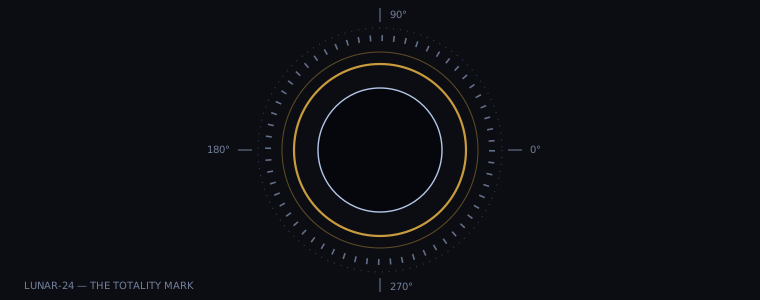
FIG. A — Divider: the totality mark,
charted. A black disc, an even corona, azimuth ticks — the same geometry the appendices
are about to measure.
AVOLTAGE REFERENCE
These are the printed panel ranges, not calibration targets.
Software normalises to ±1.0 ≙ ±10 V and 0…1 ≙ 0…+10 V.
SOURCE / PORT
LUNAR-24 PUBLISHES
HARDWARE SPEC
NOTE
EG (VCO A/B)
0…+0.8
0…+8 V
hardware spec kept
ENV (drone voices)
0…+1
−10…+10 V
kept divergence: gate-chaining sees an envelope
LFO
0…+1
0…+10 V
unipolar by design
VCO
—
10 V peak-to-peak (−5…+5 V)
1 V/oct pitch input
PULSER
±1
−10…+10 V
bipolar clock pulse
JOYSTICK X/Y
±1
±10 V, 0 V centre
offset windows −10…0 / −5…+5 / 0…+10 V
S&H
±0.5
±5 V
VOICE 3/6 MODULATOR
0…+1.2
0…+12 V
PAPA_3/6_MOD, unipolar
SEQ CV
0…+0.5
0…+5 V
hardware spec kept
SEQ GATE / keyboard gates
0…+1
0…+10 V
ENV FOLLOWER CV / GATE
0…+1 / 0…+0.8
0…+10 V / +8 V
Keyboard V/OCT
0…+0.8
0…+8 V
8 octaves
PRESSURE
0…+0.8
0…+8 V
hardware spec kept
DRY OUT (VCO A/B)
—
max 1 V
pre-filter raw voice
WET OUT
—
max 2 V
main output
EXT AUDIO / PREAMP
—
line / instrument; 1 MΩ, up to 40 dB
medium difference (1:1): hardware senses keyboard taps via a piezo under the keys; software takes external system input through the same preamp + follower (kept divergence, not a missing feature)
Power
—
12 V DC
hardware only
NOTE — These are the printed panel ranges, not calibration
targets. Patch semantics follow them exactly: the sequencer never leaves 0…+5 V, the
joystick never leaves ±10 V.
BKEPT DIVERGENCES — THE NUANCES
Where software deliberately differs, the divergence is kept, named,
and listed here.
HARDWARE RULE
LUNAR-24
ENV outs are bipolar −10…+10 V
ENV_1…6 publish 0…+1 (0…+10 V).
VOLT transposes down, then cross-FMs past half-stroke
Type — Michroma (display), Saira Condensed (text), Share Tech Mono (code and
tables); all three are OFL.
Origin — an independent instrument, inspired by classic semi-modular ambient
hardware; no hardware maker is affiliated, and no hardware firmware or manual text is
reproduced.
Engine — pure-code DSP, 48 kHz stereo; every sound you hear is synthesized
at run time.